G037
User´s Guide
Tungaloy
(-)
(-)
(+)
(-)
(+)
(+)
(-)
(-)
(+)
(-)
(+)
(+)
(-)
(-)
(+)
(-)
(+)
(+)
+
+
+
×
+
-
+
-
-
-
×
×
×
×
TGN4200
DoPent
TAW13
TME4400
TMD4400
THF4000
THE4000
A.R.
A.R.
A.R.
R.R.
R.R.
R.R.
User ’s
Gu ide-
Techn i ca l Reference
γ
p (A.R.)
γ
f (R.R.)
γ
o
Carbon steels, alloy steels
(
300HB)
Stainless steels (
300HB)
Die steels (
300HB)
Cast irons Ductile cast irons
Aluminium alloys
Copper and its alloys
Titanium and its alloys
Hardened steels (40 ~ 55HRC)
· Higher
cutting edge
strength
· Many
usable
corners of
inserts
· Excellent
chip removal
· Higher
cutting edge
strength and
Freer cutting
action
· Most
excellent
cutting
action
Shapes
of
cutting
edge
Workpiece
material
Features
T
ypical examples of mills
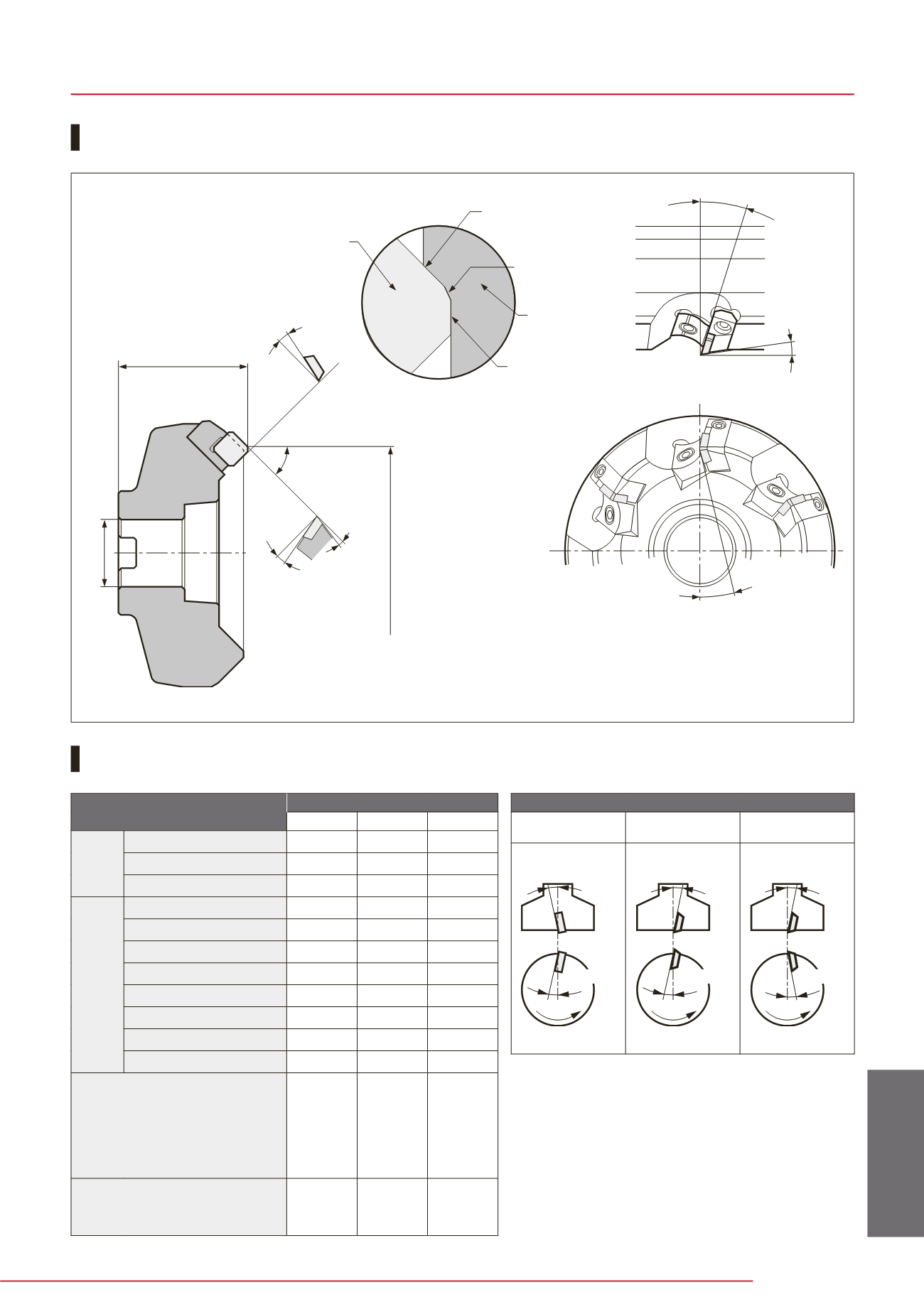
Nomenc l ature for face mi l l ing cut ter
Cut ter geomet r y and appl i cat ions
Rake angle combination and applicability
Condition
• Relations of various rake angles are
according to the following equations.
Cutter height
Peripheral
cutting
edge angle
(
κ
)
Peripheral
relief angle
True rake
angle (
γ
0
)
Cutting edge inclination (
λ
)
Effective cutter dia. (ø
Dc
)
Mounting
hole dia. (ø
d
)
Peripheral cutting edge
(Main cutting edge)
Chamfering
corner
Workpiece
Face cutting edge
(Wiping flat)
Insert
Axial rake angle (
γ
p
) (“A.R.” on catalogue)
Face relief
angle
Radial rake angle (
γ
f
) (“R.R.” on catalogue)
Axial
rake
angle
Axial
rake
angle
Axial
rake
angle
Radial
rake
angle
Radial
rake
angle
Radial
rake
angle
Negative type
(Negative-Negative) Negative-Positive type
Positive type
(Positive-Positive)
Rake angle combination
tan
γ
0
= tan
γ
f
cos
κ
+ tan
γ
p
sin
κ
tan
λ
= tan
γ
p
cos
κ
- tan
γ
f
sin
κ
Positive-Positive
Negative-Positive
Negative-
Negative
Mi l l ing tool s


