E057
Tungaloy
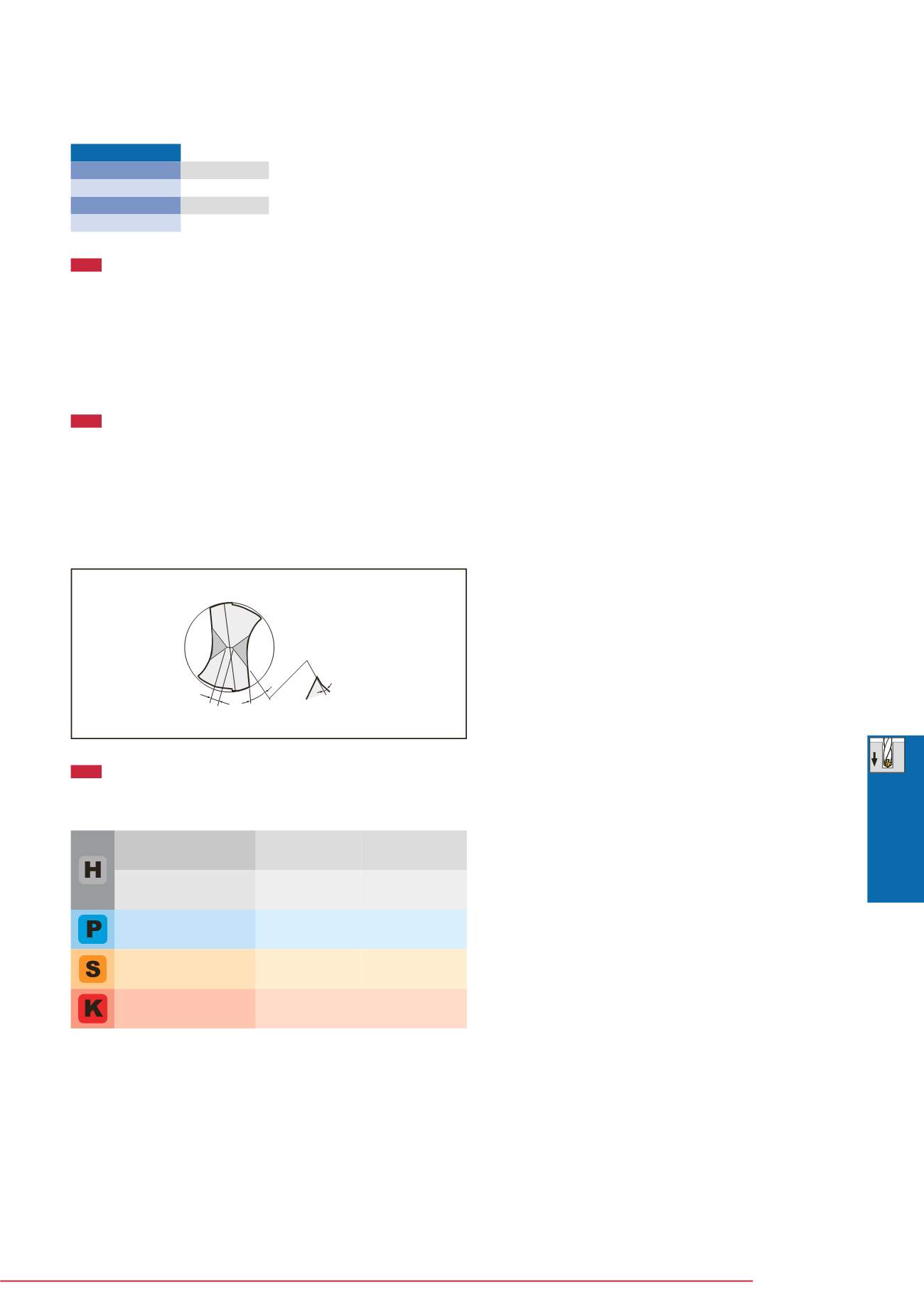
W1
20°~35°
0°~5°
2-e ective Drill
Thinning for DMD-S drills
(Rake angle of thinned part)
CAUTIONARY POINTS IN REGRINDING
STANDARD CUTTING CONDITIONS
ISO Workpiece material
Cutting speed:
Vc (m/min)
Feed:
f (mm/rev)
Hardened steels (< 50HRC)
8 - 18
0.02 - 0.1
Hardened steels (> 50HRC)
3 - 9
0.01 - 0.06
High-manganese steels
8 - 12
0.03 - 0.1
Inconel
10 - 20
0.02 - 0.08
Chilld cast irons
8 - 12
0.02 - 0.08
• No. of revolutions (min
-1
) = Cutting speed
1000
3.14
Tool diameter
• Table feed (mm/min) = No. of revolutions
Feed per revolution
øDc
Tool diameter
tolerance h7(mm)
øD
c
≤ 3
0 ~ -0.01
3 < øD
c
≤ 6
0 ~ -0.012
6 < øD
c
≤ 10
0 ~ -0.015
10 < øD
c
≤ 13
0 ~ -0.018
CAUTIONARY POINTS IN USE
The standard cutting conditions are only the general guidelines.
When using on a low rigidity drilling machine, using a small diameter
drill, or drilling a hard material, the cutting speed and feed rate
should be set lower.
Cutting edges should be honed as follows:
Honing width: 0.02 to 0.05 mm
Honing angle: - 20° to - 30°
Regrinding must be carried out before the corner wear reaches the
same as the margin width.
Use of a diamond wheel (#200 to #400) is recommended. Avoid use
of a silicon carbide wheel and hand grinding.
Thin the drill point. Cross thinning shown in the figure below is
recommended. The recommended thinning width (W1) is 1/3 to 1/4
times the web thickness. In this case, too sharp thinned edge may
cause drill breakage.


