D136
Face Milling
Notes on use of wiper insert
• When requiring good surface finishes, use of a wiper insert
(WWCW13T3AF_ R-W_ ) is recommended. In general, installing
one wiper insert delivers superior surface finishes.
• When using the wiper insert, install the insert as shown in Fig. 1.
If the insert is installed as shown in Fig. 2, breakage of the insert
is inevitable and normal surface finish can not be obtained.
• The wiper insert must not be used together with HJ-type inserts
• The wiper insert has one wiping corner.
• The peripheral cutting edge of the wiper insert is retracted from
the edge of the normal inserts. Therefore, the feed per tooth (
f
z
mm/t) of the normal insert following
the wiper insert is double that of other inserts.
• When using the wiper insert, depth of cut (
a
p) less than 1 mm is
recommended.
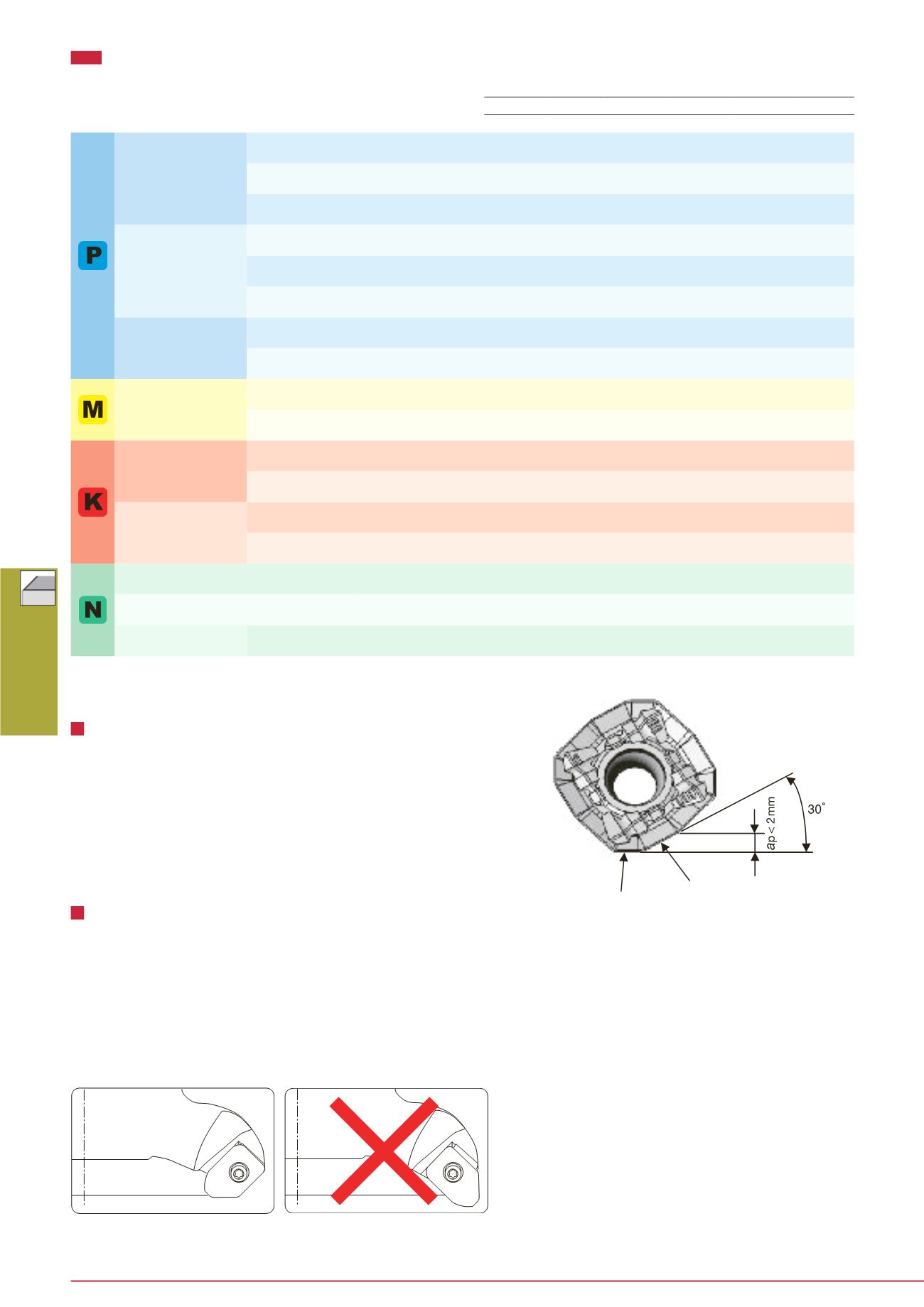
Notes for use of HJ-type inserts
HJ-type inserts can be used for high feed machining.
When using the insert, care should be taken with the following:
• The maximum depth of cut is
a
p = 2 mm. Select feeds within the above value.
• Do not use the HJ-type inserts with other types (such as MJ- and MS-types) in
the same body.
• The outer shape of the HJ-type insert is different from those of other types (such
as MJ- and MS-types), but the insert can be held in the same insert pocket.
Fig. A
Fig. B
Face Cutting edge Main Cutting edge
STANDARD CUTTING CONDITIONS
Cutting
speed
vc (m/min)
Roughing (Depth of cut: > 1.0 mm)
ISO Workpiece material
Priority
Grade
Feed per tooth: fz (mm/t)
MJ
ML
HJ
MS
Flat
AJ
Mild and
low carbon steels
E275A, etc.
< 180 HB
First choice
AH3135
AH120 100 - 270 0.05 - 0.3 0.05 - 0.25 0.2 - 0.6 0.1 - 0.25 0.05 - 0.3
-
Priority on wear
resistance
T3130 150 - 300 0.05 - 0.3
-
0.2 - 0.6
-
0.05 - 0.3
-
Priority on surface
quality
NS740 100 - 300 0.05 - 0.23
-
-
-
0.05 - 0.23
-
Carbon and
alloy steels
C45, 42CrMo4, etc.
< 300 HB
First choice
AH3135
AH120 100 - 230 0.05 - 0.25 0.05 - 0.2 0.2 - 0.5
-
0.05 - 0.25
-
Priority on wear
resistance
T3130 150 - 280 0.05 - 0.25
-
0.2 - 0.5
-
0.05 - 0.25
-
Priority on surface
quality
NS740 100 - 230 0.05 - 0.2
-
-
-
0.05 - 0.2
-
Die steels
X96CrMoV12, etc.
< 30 HRC
First choice
AH3135
AH120 100 - 180 0.05 - 0.2 0.05 - 0.2 0.2 - 0.4
-
0.05 - 0.2
-
Priority on wear
resistance
T3130 100 - 180 0.05 - 0.2
-
0.2 - 0.4
-
0.05 - 0.2
-
Stainless steels
X5CrNi18-9,
X5CrNiMo17-12-2, etc.
< 250 HB
First choice
AH3135
AH130 80 - 200 0.1 - 0.25
-
0.2 - 0.5 0.1 - 0.2
-
-
Priority on wear
resistance
AH120 150 - 250 0.1 - 0.25 0.1 - 0.2 0.2 - 0.5
-
0.1 - 0.25
-
Grey cast irons
250, 300, etc.
First choice
T1215 180 - 300 0.05 - 0.25
-
0.2 - 0.6
-
0.05 - 0.25
-
Priority on impact
resistance
AH120 150 - 250 0.05 - 0.25 0.05 - 0.2 0.2 - 0.6
-
0.05 - 0.25
-
Ductile cast irons
400-15S, 600-3, etc.
First choice
T1215 120 - 200 0.05 - 0.25
-
0.2 - 0.6
-
0.05 - 0.25
-
Priority on impact
resistance
AH120 100 - 180 0.05 - 0.25 0.05 - 0.2 0.2 - 0.6
-
0.05 - 0.25
-
Aluminium alloys
Si < 13 %
-
DS1100
KS05F 300 - 1000
-
-
-
-
-
0.05 - 0.2
Aluminium alloys
Si ≥ 13%
-
DS1100
KS05F 80 - 300
-
-
-
-
-
0.05 - 0.2
Copper alloys
-
DS1100
KS05F 200 - 500
-
-
-
-
-
0.05 - 0.2


