E035
Tungaloy
2-eective Drill
OK
OK
Guide l ines for cor rect usage of carbide dr i l l s
≤
0.02 mm
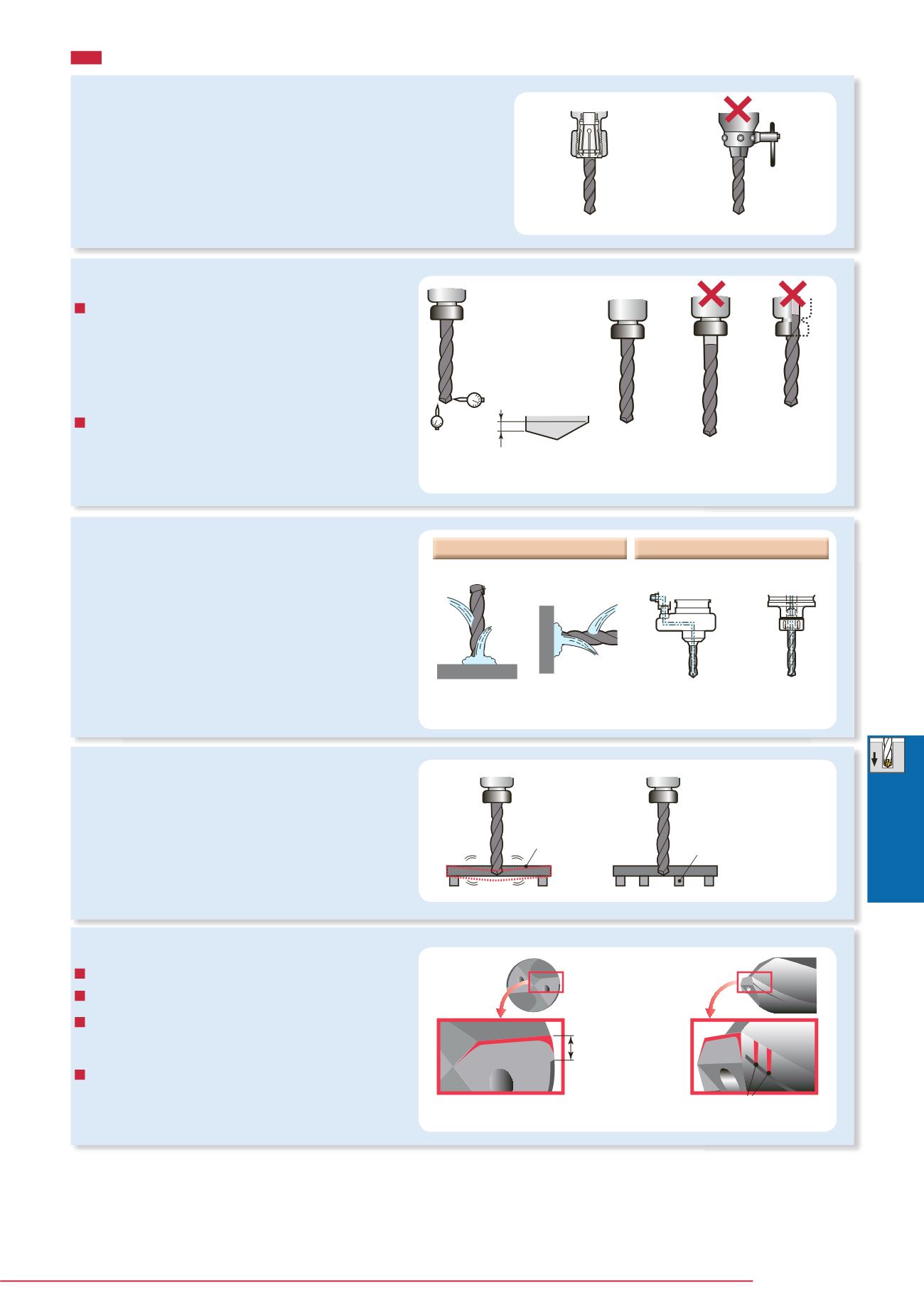
A collet chuck holder is recommended for use with carbide drills.
When using a milling chuck holder, a collet chuck with a straight
shank or straight collet should be used.
Chucking drills:
Coolant Supply:
Clamping workpieces:
The criteria of tool life:
Radial run out and lip height should be
less than 0.02mm. If run out or lip height is
larger (close to 0.05mm), machining is possible.
However, less accurate holes or short tool life may
be a result.
Overhang length should be as short as possible.
When using a drill without a coolant hole, such
as the DSW-DE type, coolant should always be
directed to the entrance of the hole. Maintaining
this supplying is very important for stable drilling
performance.
As solid carbide drills have a higher thrust force,
machining with low rigidity or inadequate support
can cause fractures or breakages through vibration.
It is important the workpiece is rigidly clamped and
has adequate support.
Corner wear width: equal to margin width
Feed mark: 1 - 2 feed marks on the margin
Spindle load increase: 30% higher than starting
level
Irregular situation: worse chip control, hole
diameter change, worse surface finish, larger
burrs, bigger sound.
Holders for solid carbide drills:
Collet chuck
Drill chuck
Lip height
≤
0.02 mm
Run out
≤
0.02 mm
Clamp the chuck
on the shank
and ensure the
overhang is as
short as possible.
Longer
overhang than
required
is not
recommended.
Do not chuck
the flute.
External coolant should be
supplied at high pressure and
directed at the hole entry point.
Coolant pressure: 0.5 - 2.0 MPa
(Air pressure for MQL: 0.3 - 0.5
MPa)
External supply
Internal supply
Vertical
Through the
rotating holder
Horizontal
Through
the spindle
Corner wear width
= margin width
Feed mark = 1 - 2 feed marks
Vibration or
deflection
Adequate support
for preventing
deflection


